
There is one invoice that almost no one questions in a startup until it hurts: the Customer Data Platform bill. You start with Segment's free plan, everything works beautifully, and six months later you discover that your product tracking costs more than your entire infrastructure.
At Venturest we went through exactly that. And the solution was not to track less —that would mean giving up on understanding the product— but to change the tool. Today I will tell you the numbers behind that decision: what Twilio Segment really costs, what Jitsu costs, and why we migrated.
The problem is not Segment. It's its pricing model.
Let's be fair: Segment is a great product. More than 450 integrations, maturity, impeccable documentation. The problem is how it charges.
Segment bills by MTU (Monthly Tracked Users): every unique user who generates at least one event per month counts, including anonymous visitors to your website. The approximate numbers for Segment's Team plan illustrate this increase:
- 1,000 MTUs: Free (Free plan, evaluation only)
- 10,000 MTUs: ~$120/month
- 50,000 MTUs: ~$350/month
- 100,000 MTUs: ~$600/month
- Business Plan (custom): From ~$25,000/year onwards
Do you see the trap? Your bill grows with your traffic, not with the value you extract from the data. If you run an acquisition campaign that brings in 40,000 anonymous visitors, your CDP charges you for them even if 95% never register. For a PLG product, where the top of the funnel is huge by design, this model penalizes exactly what you are trying to achieve: growth.
And when you exceed the Team plan and enter Business territory, the conversation goes from hundreds to tens of thousands of dollars a year.
Jitsu: Same job, different economic model
Jitsu is an open-source alternative (MIT license) to Segment: it captures events from your web, app, and backend, and routes them in real time to your data warehouse or analytics tools. Conceptually, it does the same thing as Segment at its core: collecting and distributing events.
The difference is in how you pay:
- Option 1 — Jitsu Cloud. Free up to 200,000 events per month (includes even a ClickHouse instance), and scaling per event, not per user from there. For most early-stage startups, the free tier covers full product tracking.
- Option 2 — Self-hosted. You deploy Jitsu on your own infrastructure. The cost becomes that of the servers: in a reasonable setup on AWS or any cloud, we are talking about tens of euros per month, not hundreds or thousands. Unlimited events, data at home, no surprises on the bill.
To summarize the model comparison:
- Pricing Model: Segment charges per unique user (MTU), while Jitsu charges per event (Cloud) or a flat infrastructure cost (Self-hosted).
- Anonymous Traffic: In Segment, it counts and inflates the bill; in Jitsu, it does not penalize traffic that does not convert.
- Free Tier: Segment offers up to 1,000 visitors/month; Jitsu Cloud offers up to 200,000 events/month.
- Open Source: Segment is proprietary and closed; Jitsu is open-source under the MIT license.
- Data Ownership: Segment data must flow through their cloud; Jitsu allows you to keep and process 100% of the data within your own infrastructure.
Where does Segment still win? If you rely on dozens of exotic destinations, if you want enterprise identity resolution without touching a line of code, or if your team cannot handle even a tiny bit of operations. That trade-off exists and must be said.
But if your real pipeline is 'events → warehouse → 3 or 4 destinations', you are paying for a Ferrari just to go buy bread.
How much would you save? Do the math before deciding
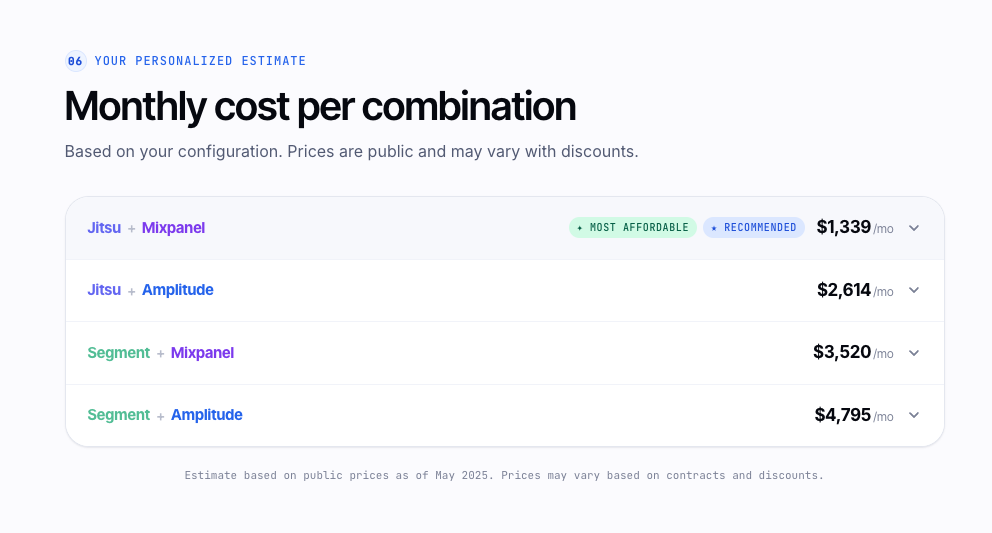
This decision is not made with opinions, it is made with your actual volume of events and users. That's why the team at DataScale Lab has built a calculator that estimates the cost of each option based on your monthly events, MTUs, and deployment type:
Calculate your Jitsu vs Segment savings with the DataScale Lab calculator. Enter your monthly event and user volume and get an annual cost comparison.
Go to DataScale Lab CalculatorFive minutes with the calculator are worth more than any generic benchmark you read out there — including this article.
Our case at Venturest: The migration that paid for itself
At Venturest we started, like almost everyone else, with Segment. It made sense: we wanted to validate the tracking plan quickly and not fight with infrastructure. But as the platform's traffic grew —and with a PLG funnel where most visitors are anonymous— the cost projection became absurd: we were paying for users who didn't even reach registration.
We migrated to Jitsu self-hosted on our own infrastructure in AWS. The result:
- Reduction of more than 85% in the cost of the event pipeline. We went from a bill that scaled with every marketing campaign to a flat and predictable infrastructure cost.
- Zero loss of analytical capability. Same events, same tracking plan, same destinations: warehouse, product analytics, and activation tools.
- An unexpected benefit: by being first-party and running on our own domain, we recovered events that ad-blockers blocked when using Segment's snippet. We literally see our users better while paying less.
The migration took us a short sprint: replicate the tracking plan, validate events in parallel for a few days, and cut the traffic. The first year's savings more than paid for the engineering hours invested.
Does this mean Segment is always a bad decision? No. It means that **the cost of your data stack is an architectural decision, not a subscription that renews on autopilot.**
My takeaways (and what I recommend)
- Understand the billing unit. Do you pay per user, per event, per row? Project that unit to your 18-month growth plan, not your volume today.
- Ask what happens to anonymous traffic. In PLG products, this is where most of the cost is hidden.
- Evaluate open source seriously. Tools like Jitsu have matured enough for production; the 'self-hosted is scary' argument from 2020 no longer holds up.
- Calculate the full TCO. Include self-hosted operational hours. Sometimes Segment pays off; many other times, it doesn't. The numbers rule.
If you are reviewing your product analytics stack and are not sure where to start —tracking plan, instrumentation, costs— it is exactly the kind of work I do with scale-ups in my Product Tracking & Analytics service.
And you? How much are you paying today for your event pipeline... and when was the last time you questioned it?